
TP-Link TL-SG108E vs TP-Link TL-SG1005P
Must the switch configure VLANs and diagnostics, supply endpoint power, or do both?
Products compared
ASIN B00K4DS5KU
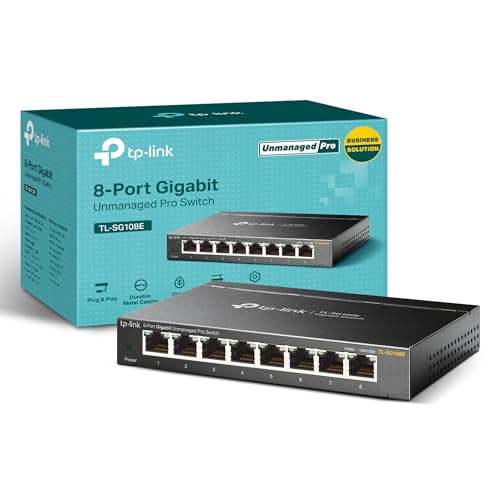
TP-Link TL-SG108E
Your network plan needs configurable switch functions and does not rely on this switch to power endpoints.
Last observed offer
$27.99
List Price: $39.99
- Confirm offer eligibility on Amazon
Size: 8 Port (Pack of 1)
Price checked
Observed condition: new. Coupon and subscription requirements unverified.

ASIN B076HZFY3F
TP-Link TL-SG1005P
You need compatible endpoint PoE power and do not need to configure VLANs or diagnostics on this switch.
Last observed offer
$39.90
List Price: $59.99
Size: 5 Port, 1 Gigabit
Price checked
Observed offer ends
Observed condition: new. Coupon and subscription requirements unverified.
Prices are per listed package. Pickoryx may earn a commission from qualifying purchases through the paid Amazon links on this page, at no added cost to you.
Published by Pickoryx · Published 2026-10-09 · Source checked 2026-10-09 20:34 UTC
The main trade-off
TL-SG108E supplies configurable switch functions without PoE output; TL-SG1005P supplies endpoint PoE power with unmanaged operation.
Quick verdict
Choose TL-SG108E for configurable VLAN and diagnostic functions with separately powered endpoints. Choose TL-SG1005P for endpoint PoE power when unmanaged operation fits, after checking the actual revision’s PoE standard, individual-port limit and total budget. If one switch must provide both capabilities, choose a different model.
Choose TP-Link TL-SG108E if
- Your network plan needs configurable switch functions and does not rely on this switch to power endpoints.
Choose TP-Link TL-SG1005P if
- You need compatible endpoint PoE power and do not need to configure VLANs or diagnostics on this switch.
When the recommendation changes
- If one switch must provide both PoE output and configurable VLAN or diagnostic functions, neither selected model meets the combination.
- If neither requirement matters, these two differences do not decide the purchase; compare the connections you need and current offers.
- If the seller cannot establish the TL-SG1005P revision and applicable power limits, resolve that before choosing it for a specific endpoint load.
The differences that matter
| Decision point | TP-Link TL-SG108E | TP-Link TL-SG1005P |
|---|---|---|
| Endpoint Power | Non-PoE: it does not supply power to connected devices.[8] | Supplies Power over Ethernet (PoE) to compatible endpoints; the applicable standard and power budget depend on hardware revision.[1, 2, 3] |
What this changes: Choose TL-SG1005P when the switch must power endpoints, after matching the purchased revision to their PoE standard, each device’s power requirement and the combined load. TL-SG108E requires a separate endpoint-power arrangement.[8, 1, 2, 3] The better fit depends on your priorities | ||
| Configurable Functions | Configurable VLAN functions, port mirroring and cable diagnostics are documented on V1 and V6; basic plug-and-play use is also supported.[6, 7] | TP-Link explicitly classifies TL-SG1005P as unmanaged.[1, 4, 8] |
What this changes: Choose TL-SG108E when you need to define virtual network groups (VLANs) or use these diagnostic controls on this switch. TL-SG1005P’s endpoint-power role does not supply that configuration capability.[6, 7, 1, 4, 8] The better fit depends on your priorities | ||
Best for your routine
Separately powered devices on a network needing switch configuration
Best fit: TP-Link TL-SG108E
Based on listed features, not comparative testing.
TL-SG108E supplies the documented VLAN and diagnostic controls. Its non-PoE design leaves endpoint power to your separate arrangement.
PoE-powered endpoints on a network that needs unmanaged expansion
Best fit: TP-Link TL-SG1005P
Based on listed features, not comparative testing.
TL-SG1005P is the power-supplying option. Check the endpoint’s required PoE standard and power against both the individual-port and combined limits of the actual revision; a camera or access-point label alone is not enough.
Value and trade-offs
One or both observed offers have eligibility conditions, so no unrestricted price difference is shown.
Compare price only after confirming the required function. Paying less for a non-PoE switch does not solve an endpoint-power requirement, and PoE alone does not replace configurable switch controls.
There is not enough verified price history here to recommend buying now or waiting; check current offers.
Limitations
- The selected retail units’ hardware revisions are unknown. TL-SG108E controls were cross-checked on V1 and V6 pages; this does not promise an identical interface or firmware across revisions. TL-SG1005P power ratings must be matched to the actual revision, not a default support-page selection.
- This is a comparison of documented functions, not hands-on throughput, reliability or security testing. “Unmanaged” describes the configuration distinction here; it does not establish a tagged-traffic passthrough guarantee or prove the absence of every built-in traffic feature.
- The exact models are TL-SG108E and TL-SG1005P. Do not substitute TL-SG108PE or TL-SG1005P-PD when checking specifications or offers.
Questions shoppers ask
Does every TL-SG1005P provide the same PoE power?
No. V1 documentation specifies 802.3af with up to 15.4 W per powered port and 56 W total; the current V6.6-linked datasheet specifies 802.3af/at with up to 30 W per powered port and 65 W total. Those are revision-specific limits, not a promise about the unit a seller will ship. Check the actual revision, endpoint standard, each required load and combined budget.
Can the TL-SG108E simply be used without configuring it?
Yes. TP-Link documents basic plug-and-play use as well as optional controls. If you need neither those controls nor PoE output, this comparison does not establish a preferred model; decide from your connection requirements and current offers.
Does PoE output mean the TL-SG1005P itself runs from a PoE cable?
Do not make that assumption. The reviewed TL-SG1005P documentation specifies an external adapter for the switch itself, as does TL-SG108E documentation. Endpoint power output and the switch’s own supply are different questions; follow the documentation for the actual unit.
Methodology and sources
Separated endpoint power from on-switch configuration. Cross-checked TL-SG108E functions on V1 and V6 pages and kept TL-SG1005P power figures tied to their documented revisions.
AI assisted source review and drafting; neither switch was tested hands-on.
View 8 sources
- 1.TL-SG1005P: US product specificationsTP-Link · Official specifications · Source checked 2026-10-09 20:32 UTC
Evidence used on this page
- Unmanaged breadcrumb line73; PoE323–325; no configuration194; revision-sensitive V5/V6 figures327–336; budget disclaimer364: Describes TL-SG1005P as an unmanaged switch with four 802.3af/at PoE ports on the displayed current product page. Its power ratings and features are revision-specific; the page does not identify the hardware version shipped by a seller.
- 2.TL-SG1005P V1: US product specificationsTP-Link · Official specifications · Source checked 2026-10-09 20:32 UTC
Evidence used on this page
- Overview234–238, PoE282, specifications321–339: The V1 page documents four 802.3af PoE ports, a 56 W total budget and operation without configuration. It also describes QoS traffic-priority features.
- 3.TL-SG1005P V1 Installation GuideTP-Link · Official specifications · Source checked 2026-10-09 20:33 UTC
Evidence used on this page
- PDF page1 notes; page2 specifications and FAQ3: The V1 installation guide specifies up to 15.4 W per PoE port and 56 W total, an external adapter for the switch, and data-only operation with non-PoE devices. These power limits apply to V1.
- 4.TL-SG1005P Unmanaged Switch DatasheetTP-Link · Official specifications · Source checked 2026-10-09 20:33 UTC
Evidence used on this page
- PDF p1 title; p2 PoE specification; p3 disclaimer and package: The datasheet linked from V6.60 support identifies TL-SG1005P as unmanaged, with four 802.3af/at ports and an external power adapter. It lists up to 30 W per powered port and 65 W total, while noting that the actual PoE budget varies with client and environmental conditions.
- 5.Download for TL-SG1005P: hardware revisionsTP-Link · Official specifications · Source checked 2026-10-09 20:32 UTC
Evidence used on this page
- Hardware selector81–100; datasheet104: The support page lists hardware versions from V1 through V6.60 and warns that availability varies by region. Its default V6.60 selection does not establish the revision of a retail unit.
- 6.TL-SG108E V6: Easy Smart SwitchTP-Link · Official specifications · Source checked 2026-10-09 20:34 UTC
Evidence used on this page
- V6 heading73; plug-and-play114; management169; mirroring/diagnostics218–219; VLAN221–222: The V6 product page documents configurable VLAN functions, port mirroring and cable diagnostics, alongside basic plug-and-play operation.
- 7.TL-SG108E V1: Unmanaged Pro SwitchTP-Link · Official specifications · Source checked 2026-10-09 20:32 UTC
Evidence used on this page
- V1 heading73; plug-and-play99; Additional Software Features114–116: The V1 product page documents VLAN functions, port mirroring and cable diagnostics despite its Unmanaged Pro name. The controls and setup method should be checked against the purchased hardware revision.
- 8.2024 TP-Link Switches Product GuideTP-Link · Official specifications · Source checked 2026-10-09 20:32 UTC
Evidence used on this page
- PDF page3/index2 lines97–123; page4/index3 lines202,270: The 2024 product guide places TL-SG108E in its Easy Smart Non-PoE range and TL-SG1005P in its unmanaged Gigabit PoE range. These model classifications do not identify the revision shipped in a particular retail offer.